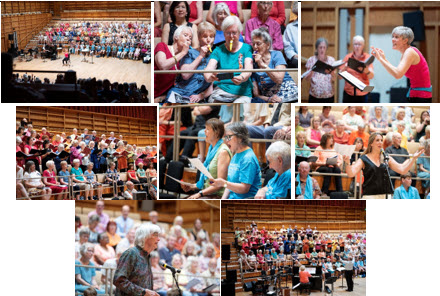
It was a very special day on Saturday June 20th when all the strands of Canterbury Cantata Trust came together, sharing our common principle of “Caring through Singing” and fund-raising for the Parkinson’s Centre for Integrated Therapies. Our founder and honorary president, Professor Grenville Hancox, opened the event and reminded us of the importance of what the Trust does, carrying on his innovative work and building on those first ideals of providing singing opportunities for all.
A heartfelt thank you to each and every one of you who joined us to create a community of music-makers, connecting with others to sing for our physical, emotional and mental well-being, embodying everything the Trust stands for. Thank you also to our sponsors, James Owen Hearing, Oak Foundation and Kent Community Foundation who are vital to our continuing work which enhances the lives of so many.
For us to perform Phil Self’s carefully and artfully written folk-themed piece designed with all the individual groups in mind was a long-held dream and the band, led by Phil, together with the wonderfully narrated text brought the piece to life so vividly… the themes are still running round my head!
Congratulations to all who came to be a part of this celebration and, in particular to Emily, Stelios and Lucy (and of course, the vital accompanists) who helped us to convey the joy of singing together so clearly for all to see!
I am delighted to share below a heart-warming review of the Trust celebration by the newest member of our board of Trustees, Dr. Emily Sayers who came along to the event and captured the fun, emotion and caring atmosphere beautifully.
Roshna Ahmad
Chair, Canterbury Cantata Trust.
As the newest trustee of Canterbury Cantata Trust, I arrived at my second CCT concert expecting to take away a memory of an afternoon of excellent music making. What I experienced was something much more profound, however, a vivid demonstration of the Trust’s mission of caring through singing, and a well-used kazoo to take away to help warm up and protect my own voice!
The afternoon opened with a reminder from Professor Grenville Hancox of the primacy of musical communication and the importance of both singing and listening as acts of care. Those themes resonated throughout the programme. From the Amici Chorus’s spirited performance of Verdi’s Anvil Chorus, sensitively accompanied by Helen Crayford, to the infectious enthusiasm of the Skylarks and Monday Music singers, every performance celebrated the power of singing to bring people together. Emily Renshaw-Kidd, Lucy Gove, Stelios Chatziiosifidis and Richard Ansell guided performers and audience alike with warmth, skill and imagination. Emily donned a simple piece of turquoise fabric to transform into a Skylark and invited us all to share in the songs, movements and musical experiences that have become so meaningful to the singing communities she leads. Alongside contributions from Matt Shipton of the Sing to Beat arm of the charity, and Professor David Wilkinson, director of the Parkinson’s Centre for Integrated Therapies, the afternoon provided powerful reminders that music is not simply something we perform, but something through which we connect, communicate and care for one another.
The culmination of the concert was the première of Tend the Flame, a newly commissioned work by Phil Self. Drawing on myths, legends and landscapes from across Britain and Ireland, the work carried us through stories of fire sprites (including the ever-present Kila), giants, selkies, banshees and barley men. Simon Paisley Day’s narration served as a compelling thread throughout the work, guiding the audience through the unfolding journey with masterful clarity, warmth and dramatic intensity. Supported by an inventive folk-inspired ensemble, including composer Phil Self (guitar), Stewart Hughes (drums), Aidan Shepherd (accordion), Jacob Berry (trombone) and Stelios Chatziiosifidis (violin), the score moved between hymn, ballad, sea shanty and drinking song. Particularly memorable were the haunting sonic landscapes created through extended instrumental techniques, including bowed cymbals that seemed to echo the wail of banshees across dark waters. For me, the most unforgettable moment came as the travellers greeted the sunrise. As the singers soared above the texture with growing fervour, the music seemed to embody hope itself, a fitting conclusion to an afternoon dedicated to tending the flame of human connection through singing.
If this concert demonstrated anything, it is that Canterbury Cantata Trust’s work extends far beyond performance. Through regular and sustained opportunities to engage with music,
storytelling, participation and community, it creates spaces where people can belong, flourish and care for one another across age groups. As a trustee, I left feeling both inspired and enormously optimistic about the future of this remarkable organisation.
Dr. Emily Sayers